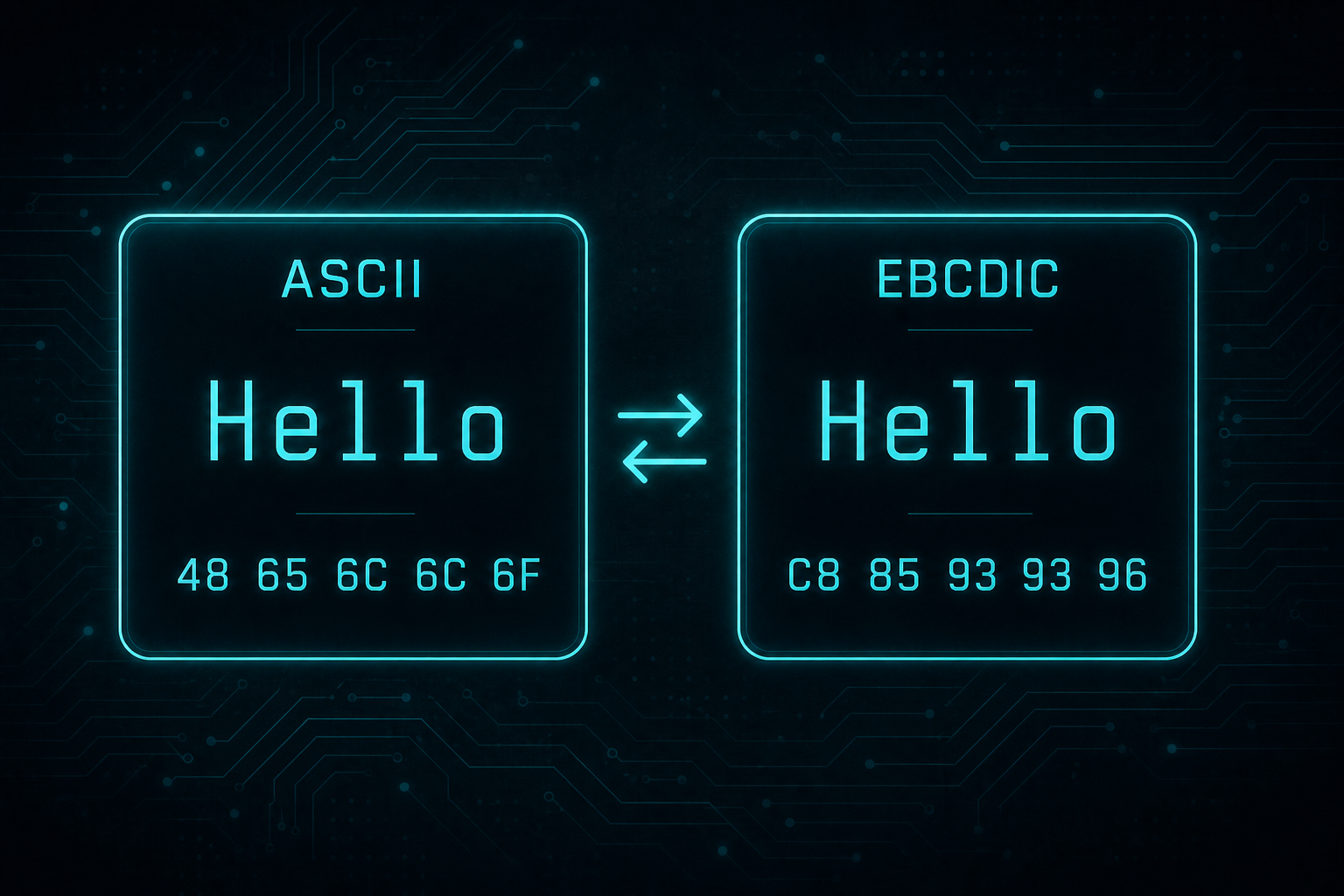
ASCII & EBCDIC
Enter a string to see ASCII and EBCDIC hex and decimal byte values. Uses IBM code page 037 (US English EBCDIC).
How ASCII and EBCDIC character codes work
Two different byte mappings for text
Computers store text as numbers. ASCII (American Standard Code for Information Interchange) maps basic English letters, digits, and control codes to values 0–127. EBCDIC (Extended Binary Coded Decimal Interchange Code) is an IBM family of encodings that dominated mainframes; the same letter often has a completely different byte value than in ASCII.
This page encodes your string as ASCII hex/decimal bytes and as IBM code page 037 (US English EBCDIC) hex/decimal bytes so you can compare the two worlds side by side.
Why EBCDIC still appears
Banks, insurers, and government systems still exchange mainframe datasets where EBCDIC is assumed. Copying a file as if it were UTF-8/ASCII produces mojibake or wrong sort order. Seeing both encodings for the same characters helps debug those pipelines.
Worked example
The ASCII code for A is decimal 65 (hex 41). In EBCDIC CP037, A is decimal 193 (hex C1). Digits and punctuation also move: never assume a hex dump from a mainframe uses ASCII columns.
Limits of this tool
Only characters that exist in classic ASCII / CP037 maps are shown cleanly. Modern Unicode text (emoji, most accented scripts) needs UTF-8 — see UTF-8 & Unicode. Different EBCDIC code pages (037 vs 1047, etc.) disagree on some symbols; this page documents CP037.
Common mistakes
- FTPing a text file in binary vs text mode across ASCII↔EBCDIC hosts.
- Reading a hex dump with an ASCII chart when the dataset is EBCDIC.
- Assuming Latin-1 or Windows-1252 is “ASCII” for bytes above 127.
FAQs
- Is ASCII the same as UTF-8?
- UTF-8 matches ASCII for bytes 0–127, then uses multi-byte sequences for other Unicode characters.
- Where is Base64?
- Base64 Encoding transports bytes as text; it does not replace character-set mapping.
Related: UTF-8 & Unicode, Bits & Bytes, Number Bases.
Last updated: July 2026