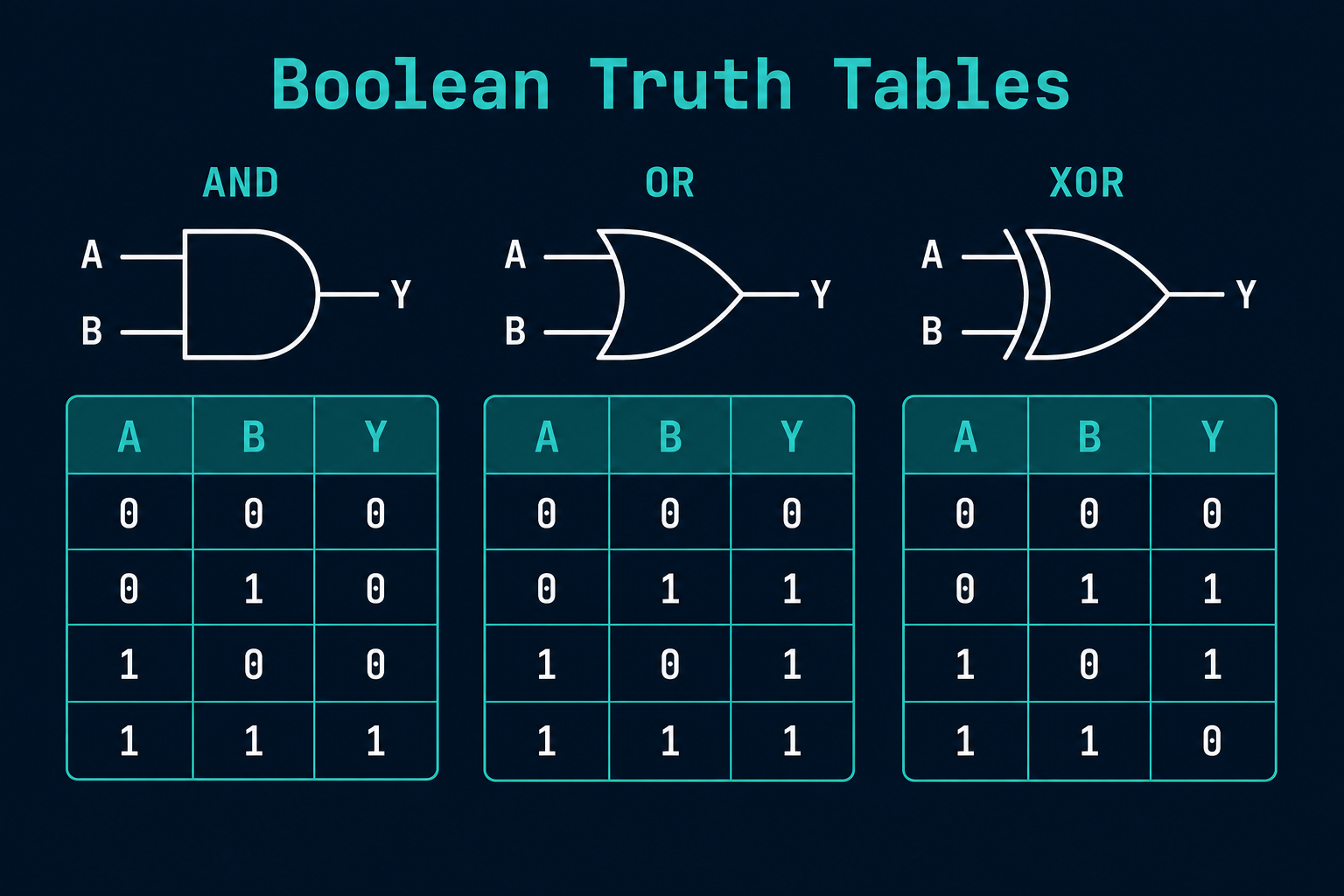
Standard logic gates
Each table lists every input combination and the output (0 or 1). These are the building blocks digital circuits use to store and process bits.
| A | B | Out |
|---|---|---|
| 0 | 0 | 0 |
| 0 | 1 | 0 |
| 1 | 0 | 0 |
| 1 | 1 | 1 |
| A | B | Out |
|---|---|---|
| 0 | 0 | 0 |
| 0 | 1 | 1 |
| 1 | 0 | 1 |
| 1 | 1 | 1 |
| A | B | Out |
|---|---|---|
| 0 | 0 | 1 |
| 0 | 1 | 1 |
| 1 | 0 | 1 |
| 1 | 1 | 0 |
| A | B | Out |
|---|---|---|
| 0 | 0 | 1 |
| 0 | 1 | 0 |
| 1 | 0 | 0 |
| 1 | 1 | 0 |
| A | B | Out |
|---|---|---|
| 0 | 0 | 0 |
| 0 | 1 | 1 |
| 1 | 0 | 1 |
| 1 | 1 | 0 |
| A | B | Out |
|---|---|---|
| 0 | 0 | 1 |
| 0 | 1 | 0 |
| 1 | 0 | 0 |
| 1 | 1 | 1 |
| A | Out |
|---|---|
| 0 | 1 |
| 1 | 0 |
Arithmetic using gates
How boolean truth tables work
Every combination of inputs
A truth table lists outputs of a boolean expression for each possible true/false (1/0) input pattern. This page evaluates common logic operations so AND, OR, XOR, NAND, NOR, and implication become concrete instead of memorised slogans.
Worked example
AND is true only when both inputs are true. XOR is true when inputs differ. Those single-bit rules are the same ones CPUs apply across whole registers in Bitwise Operations.
Common mistakes
- Confusing implication (→) with IF statements in programming languages that short-circuit differently.
- Mixing boolean logic with bitwise operators on integers casually.
FAQs
- Why teach tables if languages have &&?
- Tables make completeness proofs and digital logic circuits easier to reason about.
When this page helps
Use it when you want a transparent, browser-side calculation with the assumptions spelled out — then verify anything high-stakes against primary docs, a professional, or your own measurements. The related links below point to sibling tools and longer guides when you need more context.
Accuracy notes
Results depend entirely on the numbers you enter and the simplified model described above. Device clocks, tape measurements, market rates, and recipe conventions can all differ from a perfect textbook case. If an output looks surprising, re-check units first, then re-read the formula section.
Related: Bitwise Operations, Number Bases.
Last updated: July 2026