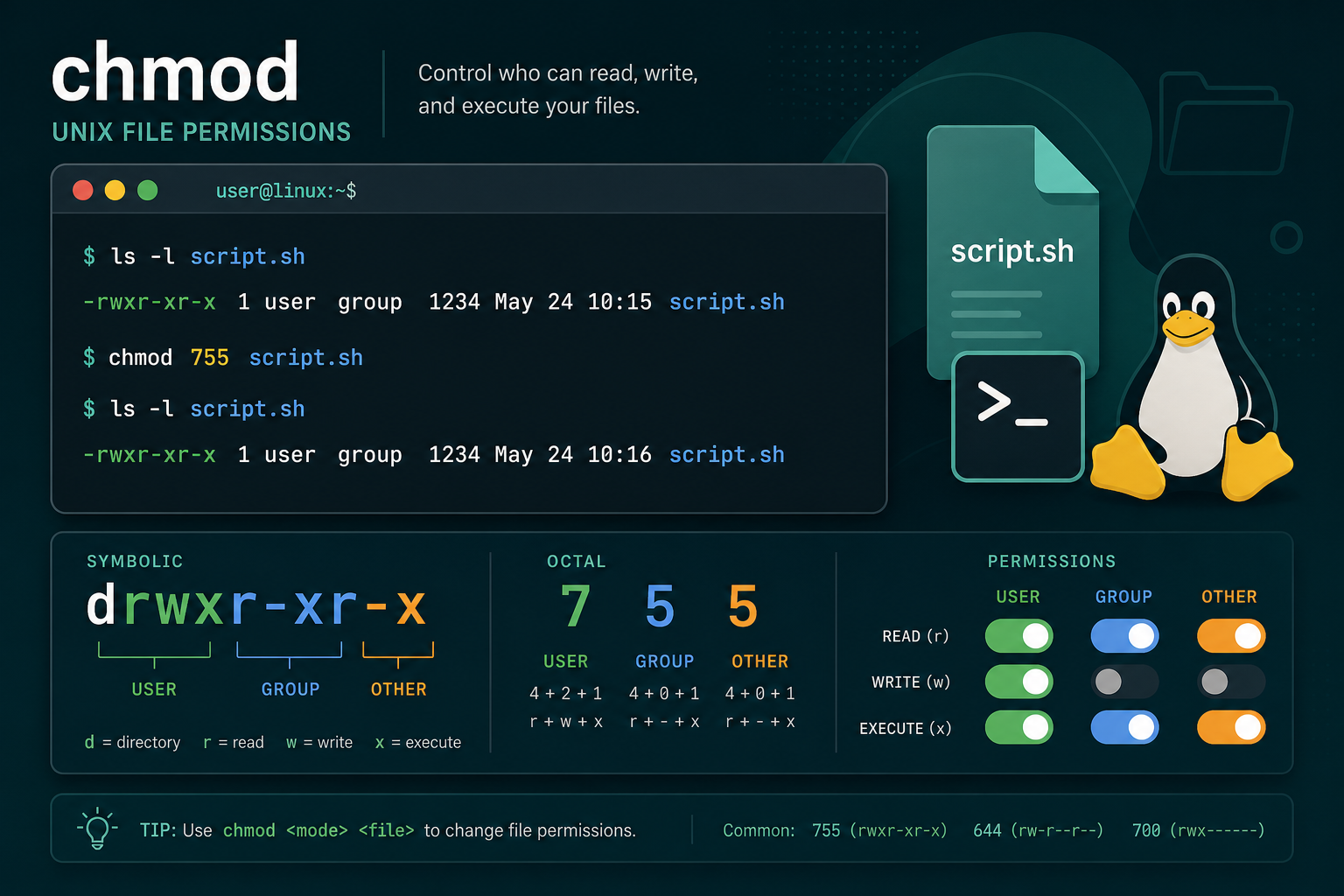
chmod permissions
Toggle read, write, and execute bits for user, group, and other. Special bits: setuid, setgid, and sticky.
User
Group
Other
How Unix file permission modes work
Owner, group, others — read, write, execute
Classic Unix permission bits grant read (r), write (w), and execute (x) to three classes: user (owner), group, and others. Modes are often written as octal (e.g. 755) or symbolic strings (rwxr-xr-x). This page converts among those views so chmod arguments become readable.
Worked example
755 means owner rwx (7), group r-x (5), others r-x (5) — common for executable programs. 644 is rw-r--r-- for ordinary files. Privileged setuid/setgid/sticky bits are advanced cases explained in the full guide.
Common mistakes
- Using
777“to make it work” on shared hosts. - Forgetting execute on directories (needed to traverse them).
- Confusing ACL extras with the basic nine bits.
FAQs
- Why octal?
- Each digit packs three bits — see also Number Bases.
- Guide?
- Unix/Linux file permissions explained.
When this page helps
Use it when you want a transparent, browser-side calculation with the assumptions spelled out — then verify anything high-stakes against primary docs, a professional, or your own measurements. The related links below point to sibling tools and longer guides when you need more context.
Accuracy notes
Results depend entirely on the numbers you enter and the simplified model described above. Device clocks, tape measurements, market rates, and recipe conventions can all differ from a perfect textbook case. If an output looks surprising, re-check units first, then re-read the formula section.
Related: Number Bases, Bitwise Operations.
Last updated: July 2026