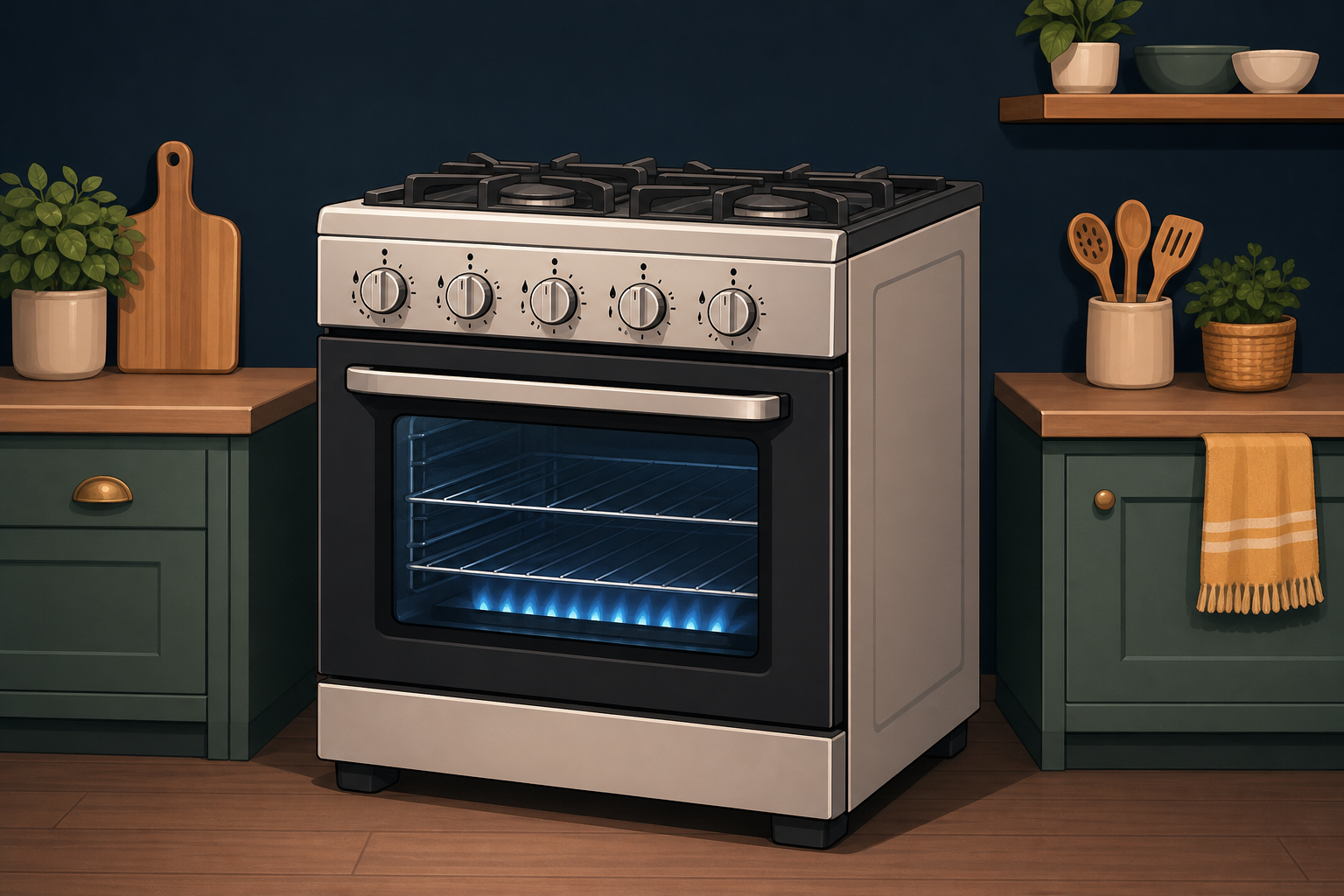
Gas Mark, Celsius, and Fahrenheit
Choose a UK gas mark; conventional and fan (convection) oven settings appear in °C and °F. Values follow common UK recipe scales (approximate oven settings).
Conventional Oven
Fan Oven
How UK gas mark oven temperatures work
Gas mark versus thermometer settings
Older and many UK recipes specify heat as a gas mark (an integer on a domestic gas oven dial) rather than a Celsius thermometer reading. Electric and fan ovens usually want °C or °F. This page maps a chosen gas mark to common conventional and fan (convection) temperatures in both Celsius and Fahrenheit.
Values follow widely published UK recipe correspondence tables. They are practical cooking approximations — oven thermostats vary, and “fan” recipes often run cooler than conventional for the same browning.
Typical relationship
As gas mark rises, temperature rises roughly in steps of about 10–20 °C. Fan settings are commonly shown around 20 °C lower than the conventional column for the same gas mark, matching advice printed in many British cookbooks. Always defer to your appliance manual if it conflicts.
Worked example
Gas mark 6 is often listed near 200 °C conventional (about 400 °F), with a fan setting near 180 °C (about 350 °F). A Victoria sponge that says “gas mark 4” is a moderate oven; breads and pizzas usually sit higher.
Tips for better results
- Preheat fully; many ovens reach air temperature before shelves and stoneware do.
- Use an oven thermometer if bakes run consistently pale or burnt.
- For food science temperatures not tied to gas mark, use the Temperature converter.
Common mistakes
- Treating fan and conventional °C as interchangeable without adjusting recipes.
- Converting with a simple °C↔°F formula while ignoring that gas mark tables are recipe conventions.
- Using grill/broiler marks as if they were oven gas marks.
FAQs
- Are these exact physics conversions?
- No — they are culinary lookup values linking dial marks to typical set points.
- What about Celsius-only recipes?
- Enter through Temperature if you only need °C ↔ °F ↔ K.
Related: Temperature, Nutrition, Celsius / Fahrenheit guide.
Last updated: July 2026